On this page
- Your biggest cost lever is often the parcel itself — smaller, tighter packaging cuts chargeable weight.
- Consolidating several orders into one shipment spreads the fixed per-shipment fee.
- Accurate addresses and consistent declarations prevent surcharges, holds, and rework.
- Remote-area add-ons can erase a cheap headline rate, so check the destination ZIP.
- Every saving trades against speed, tracking quality, or delivery certainty — choose deliberately.
Shipping quietly eats order margin. A parcel that costs a few dollars too much can wipe out the profit on a low-priced item.
The good news: you control several of the biggest cost drivers. This guide focuses on the cost levers that are actually yours to pull, and on what each saving costs you elsewhere.
Where the money actually goes
Before cutting anything, know what you are paying for. A parcel bill usually mixes weight, a fixed handling fee, and add-ons.
The charging logic — actual weight versus volumetric weight — is covered in detail in our chargeable weight guide. The fee and surcharge checklist sits in the quote-comparison guide. Neither is repeated here.
What matters for this article is the split: some costs scale with the parcel, some are fixed per shipment, and some are avoidable mistakes.
Economic lines: the options
For low-cost direct shipping, two options dominate. Both move parcels in bulk and hand off locally.
| Option | Cost | Tracking & speed | Best for |
|---|---|---|---|
| Economy parcel line | Low, with a per-shipment fee | Tracked, moderate transit | Most ecommerce parcels |
| Postal economy tier | Cheapest on very light items | Weaker tracking, slower | Small, light, non-urgent goods |
The full three-way choice between parcel lines, express, and postal is explained in our method comparison. For real cost examples by weight, see the 1kg and 2kg cost breakdown.
Saving levers you control
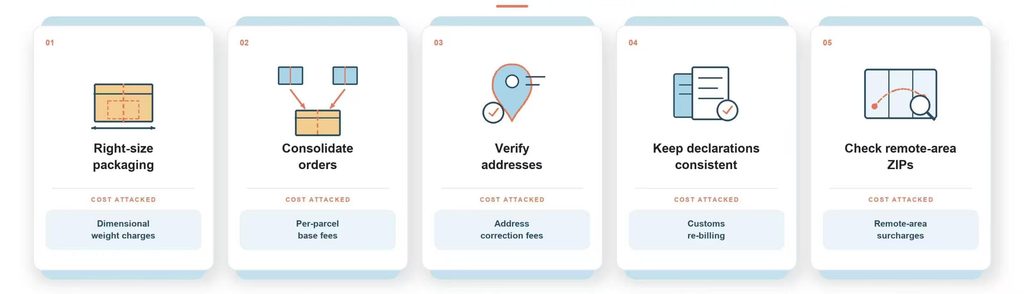
Five practical moves lower the bill without changing carriers. Each one attacks a different cost.
| Action | What it saves | Watch out for |
|---|---|---|
| Right-size packaging | Lower chargeable weight | Enough protection for transit |
| Consolidate orders | Fewer per-shipment fees | Longer dwell before dispatch |
| Verify addresses | No redelivery or correction fees | Unit numbers and ZIP accuracy |
| Keep declarations consistent | Fewer holds and rework | Invoice and label must match |
| Check remote-area ZIPs | Avoids remote surcharges | Carrier’s remote-zone list |
Consolidation works in two specific cases: combining multiple items from the same buyer into one order, or collecting stock for onward distribution from an overseas warehouse. It is not a reason to merge parcels from different buyers.
Because part of the fee is fixed per shipment, one larger parcel usually costs less than several small ones.
Stop consolidating once the combined parcel passes the economy line’s weight or dimension cap — such as a 2 kg small-parcel limit. The shipment then has to move on a higher-priced channel.
One surcharge deserves a precise rule. While postal tiers usually charge a flat nationwide rate, commercial-backed economy lines often add remote-area surcharges — so always check the destination ZIP against your carrier’s remote-zone list.
Worked cost example: packaging alone
A 350 g hoodie shows how much the box decision moves the bill. In a rigid carton its volumetric weight is 850 g; in a tight poly mailer it bills at its real 350 g. On an economy line at $9 per kilo plus a $2 handling fee:
| Line item | Rigid carton | Poly mailer | Saving |
|---|---|---|---|
| Chargeable weight | 850 g (volumetric) | 350 g (actual) | −500 g |
| Weight charge at $9/kg | $7.65 | $3.15 | −$4.50 |
| Handling fee | $2.00 | $2.00 | — |
| Total per parcel | $9.65 | $5.15 | $4.50 (46%) |
That is $4.50 off a single parcel — over 46% — without changing carrier or service level. Right-sizing pays before you negotiate any rate.
The trade-offs behind every saving
Cheap is never free. Each cut gives up something, and you should know which.
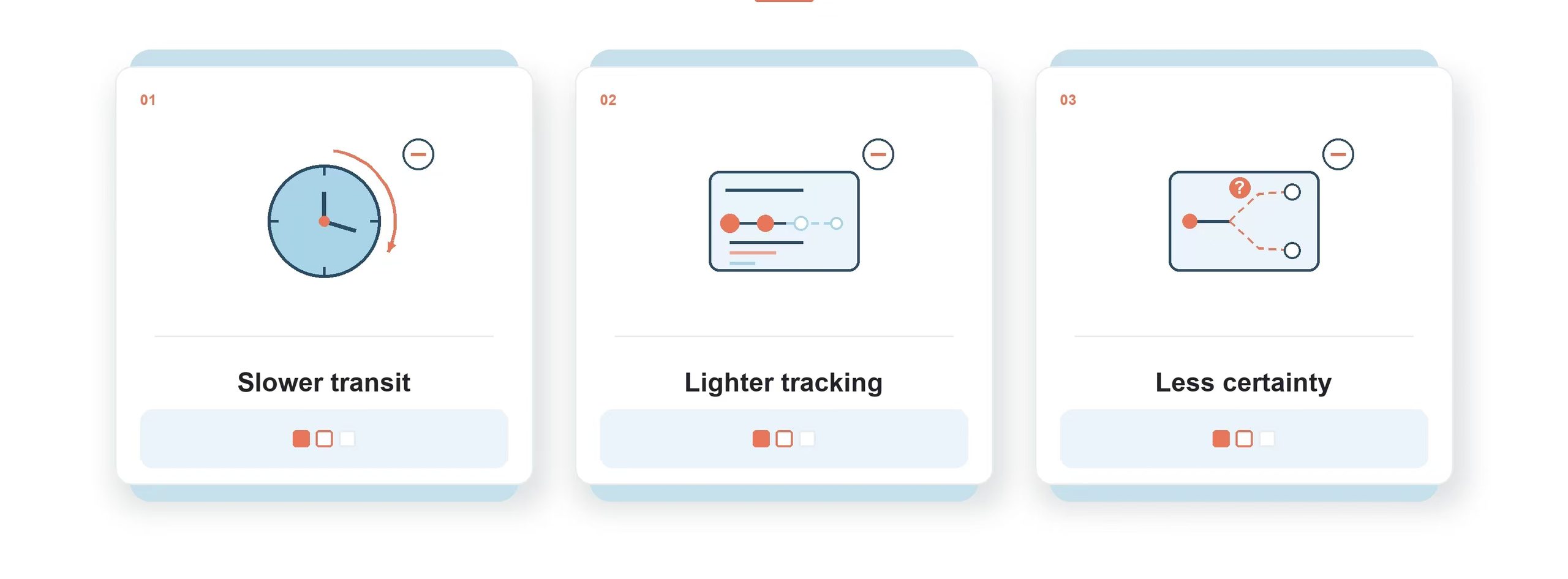
- Slower transit — economy lines take longer, which can hurt conversion if buyers expect speed.
- Lighter tracking — postal tiers often have fewer scan points, so problems surface later.
- Less certainty — low-cost services may offer weaker delivery guarantees on difficult addresses.
Match the saving to the product. Non-urgent, low-value, lightweight items tolerate these trade-offs well. Bestsellers and high-value orders usually do not.
A decision checklist
Before you switch to a cheaper option, run through four questions:
- Will the buyer accept the slower delivery window?
- Does the parcel still track well enough to answer “where is my order”?
- Have I right-sized the packaging and checked the destination ZIP?
- Is the all-in total lower once fees and surcharges are included?
If all four check out, the cheaper line is a real saving. If not, the headline rate is hiding a cost.
A simple rule of thumb by order value
How much you save should track the value of what you ship. Two bands cover most decisions:
| Average order value | Default channel | Cost discipline |
|---|---|---|
| Under $15–$20 (light, non-urgent) | Postal or economy small-parcel line | Keep shipping within 20–30% of order value; accept slower transit. |
| Over $40, or a repeat-buy bestseller | Tracked ecommerce line with stable transit | Pay for certainty — one refund costs far more than the $2–$3 saved on freight. |
These are starting thresholds, not hard rules. Adjust them to your margin and to what your buyers expect.
Remember the wider tax picture too. Since the US ended its $800 de minimis exemption, duty now applies to China parcels at every value, so a low freight rate says nothing about the landed cost.
To see the real number, work it out line by line:
True landed cost per order = Product COGS + Packaging + (Chargeable Weight × Rate + Handling Fee + Surcharges) + Import Duty/Tax + Expected Return/Loss Buffer
The return and loss buffer is easy to skip, but on cross-border orders it is real. Price from this total, not from the freight line alone.
You can check our customs and duty guide to estimate the tax side before pricing your products. For the policy background, the Congressional Research Service tracks the end of de minimis and its effect on ecommerce imports, and US Customs and Border Protection publishes the current entry rules.
Explore our ecommerce direct shipping and lightweight parcel options, or request a quote to price the all-in cost of your cheaper line.
Frequently asked questions
What is the biggest lever for cutting parcel cost?
The parcel itself. Right-sizing packaging lowers chargeable weight, because carriers bill on the greater of actual and volumetric weight. Tighter cartons often cut cost faster than haggling over rates.
Does consolidating orders really save money?
Often yes. Part of the fee is fixed per shipment, so sending one larger parcel can cost less than several small ones, as long as the combined parcel stays within the line’s weight and size cap (such as 2 kg).
How do I avoid remote-area and other surcharges?
Check the destination ZIP against the carrier’s remote-area list before you quote. Also verify addresses and keep the commercial invoice consistent with the label to prevent correction fees and holds.
When is postal economy better than an economy parcel line?
Under roughly 200–300 g, and when the item is low-value and the buyer is not sensitive to transit time, a postal economy tier has the clearest chargeable-weight advantage. Once a parcel passes about 500 g, an ecommerce parcel line usually wins — it has a fixed handling fee but a lower per-kilo rate.
How can I reduce volumetric weight without risking transit damage?
Swap rigid cartons for poly mailers or bubble bags on non-fragile goods such as apparel and plush items. Removing dead air from the corners cuts the dimensions that drive volumetric weight, so the parcel bills lighter without exposing the product to crushing.
How do I price low-ticket items after de minimis ended?
Price from landed cost, not from the product cost alone. Add packaging, the chargeable-weight freight, handling, duty and tax, plus a return or loss buffer, then set the margin you need. Since the US ended its $800 de minimis exemption, even low-value parcels carry duty, so a cheap freight rate is not a cheap landed cost. Bundling a few units into one order spreads the fixed fee across more margin.