Sur cette page
- A quote is not a delivery promise — add the hidden days before the clock starts.
- Use the buffer formula below to turn any quote into a storefront delivery window.
- Fix the common delays before dispatch: correct HS code, local phone number, EDI paperwork.
- When a parcel stalls, the fix depends on where it stopped: before induction, before departure, or in customs.
- Match the stall point to the right person to chase, instead of waiting and guessing.
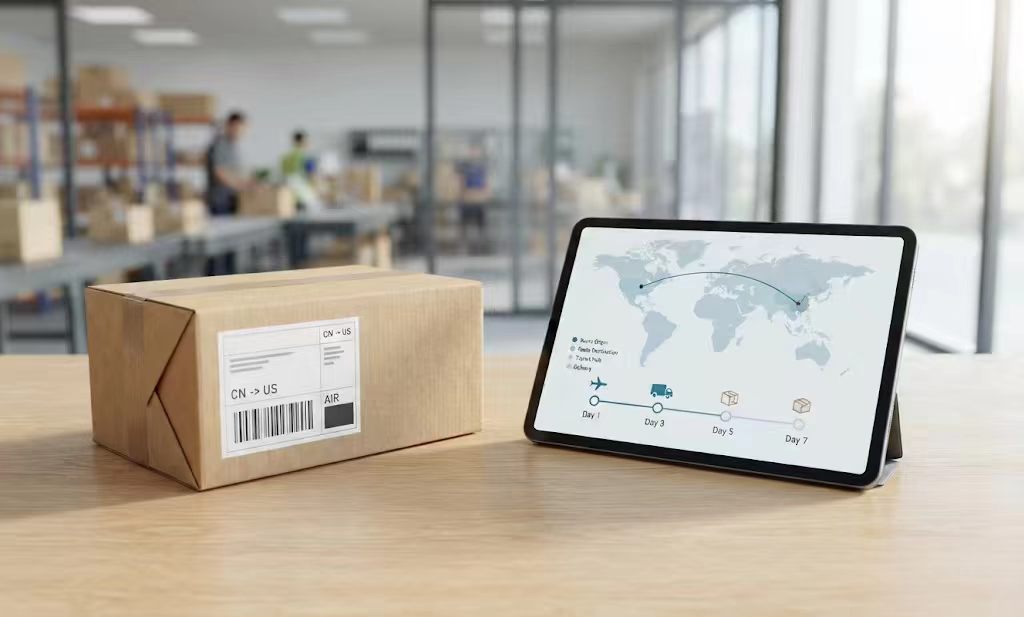
Two sellers ship on the same line and quote the same “7-day” transit. One parcel arrives in a week; the other takes twelve days. The difference usually has nothing to do with the line and everything to do with how the time was counted.
This article gives you the tools to count it properly. You will get a buffer formula for the delivery window you show buyers, a pre-dispatch checklist that removes common delays, and a diagnostic playbook for a stalled parcel.
Why transit expectations drift
Most delivery complaints come from a mismatch, not a delay. The buyer counted from the order date; the carrier counted from departure.
When both sides use a different starting point, the same parcel feels late to one and on time to the other. Fix the definition and most of the friction disappears.
When the clock starts
Every transit figure attaches to a specific event. Identify the event before you trust the number.
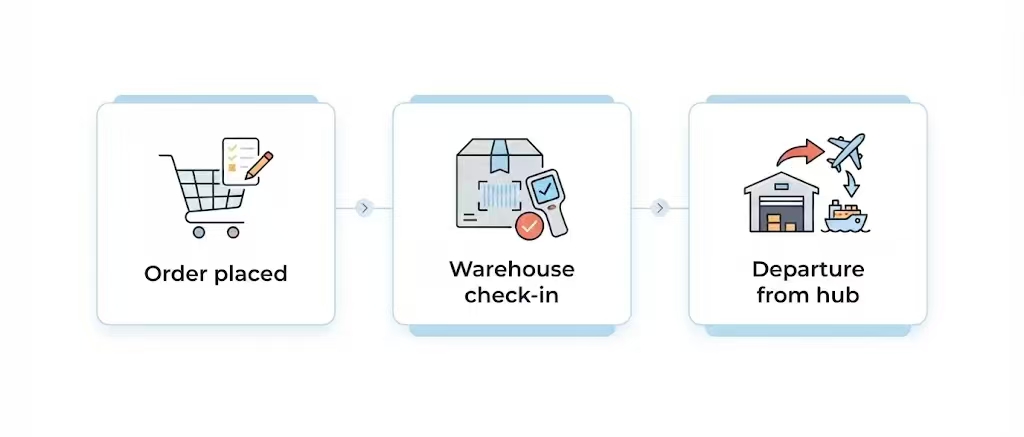
| Start event | What the day count includes | What it excludes |
|---|---|---|
| Order placed | Everything (supplier prep, domestic transit, export, flight, clearance, last mile) | Nothing (rarely used by carriers) |
| Warehouse check-in | Sorting, export customs, flight, destination clearance, last mile | Supplier pickup and first-mile handoff |
| Departure from hub | Mainline flight, destination clearance, last mile | Domestic pickup, warehouse processing, and export handling |
The “5-day” figure you see on fast lines is a good example. It starts after the parcel is inducted at the origin hub and flown to Europe — not when it leaves the factory.
You can see how line-haul routing works in our breakdown of the 5-day express mechanism and how parcels move through a regional transit hub.
Working days vs calendar days
A “7-day” service can mean seven working days or seven calendar days. That choice changes the date your buyer expects.
| Basis | How it counts | The trap |
|---|---|---|
| Calendar days | Every day, including weekends | Looks shorter, may slip on weekends |
| Working days | Business days only | Holidays extend the real arrival date |
Always ask which basis a quote uses. Then add public holidays at both ends — Chinese New Year and Western holiday peaks routinely stretch real transit well beyond the published figure.
Hidden days the quote leaves out
A quote covers the line, not the whole door-to-door journey. The table lists the stages that usually sit outside it.
| Hidden stage | Typical extra time | Counted in the quote? | What shortens it |
|---|---|---|---|
| Supplier pickup to origin warehouse | 1–3 days | No — before check-in | Book pickup early, confirm handoff date |
| Check-in, sorting, export filing | 0.5–1 day | Only if the clock starts at check-in | Pre-upload invoice and HS data |
| Cut-off and flight scheduling | 0–1 day | No | Deliver before cut-off in writing |
| Destination customs review | 1–3 days | Sometimes | File IOSS and invoice data before arrival |
| Last-mile handoff | 1–2 days | Usually | Confirm local phone and full address |
| Weekend and holiday spill | 1–3 days | No | Add a calendar buffer |
Door-to-door buffer formula
Use this formula the moment you get a quote. It turns a line number into a window you can show on your storefront. The quote already covers normal clearance and last-mile delivery, so the buffers below are extra allowances for delays and congestion — not a second count of those base steps.
Worked example. A forwarder quotes 7 working days from departure — roughly 9 to 11 calendar days. Add 2 days for pre-departure pickup and handling, plus extra buffers for congestion (2 days for customs review, 1 day for last-mile handoff, and 2 days for holidays). You land at 14 to 18 calendar days.
Show buyers “14–18 days,” not “7 days.” A wider, honest window cuts “where is my order” messages and review damage at the source. Recalculate it whenever the route, season, or start event changes.
Preventive checklist: fix delays before dispatch
The five common delay risks look abstract until you attach an action to each one. Run this checklist before the parcel leaves your hands.
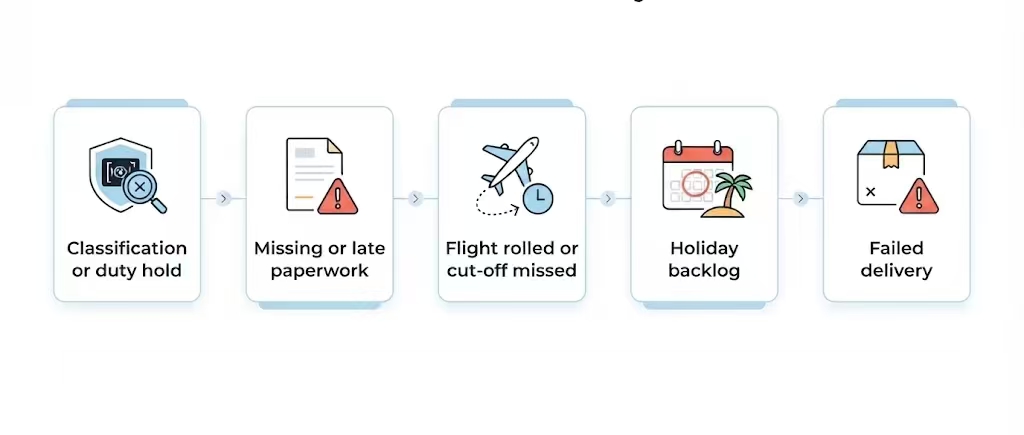
| Delay risk | Pre-dispatch action | Owner |
|---|---|---|
| Classification or duty hold | Verify the 6–10 digit HS code matches the goods and the destination tariff; check the current duty status | Seller + broker |
| Missing or late paperwork | Transmit the commercial invoice and IOSS data by EDI before departure, and keep the transmission receipt | Vendeur |
| Flight rolled or cut-off missed | Book space before cut-off and get departure confirmation in writing | Forwarder |
| Holiday backlog | Check origin and destination holiday calendars, then widen the displayed window | Vendeur |
| Failed delivery | Require a local phone number at checkout and verify the ZIP and unit number | Vendeur |
Two items do most of the work. A correct HS code prevents most customs holds, and a local phone number prevents most last-mile failures. Neither costs money — both take minutes before dispatch.
Customs on both sides of the Atlantic
Customs deserves a closer look on both sides of the Atlantic. Since the US ended de minimis eligibility for shipments from China in 2025—and tightened low-value entry rules globally—more parcels now face formal customs review and duty assessment rather than automatic clearance.
EU-bound parcels follow a parallel path: IOSS collects VAT at checkout and low-value imports now draw more formal scrutiny than before.
You can check our customs documentation checklist to see the paperwork that keeps that step fast. US Customs and Border Protection details the low-value entry process, and major carriers such as UPS publish their transit commitments as a benchmark.
Post-shipping playbook: diagnose a stalled parcel
Even with clean paperwork, a parcel can stop. The fix depends on where it stopped. Find the last scan, match it to one of the three nodes below, and chase the right party.
| Stall point | Typical last scan | Check first | Who to chase |
|---|---|---|---|
| Before induction | “Label created,” “awaiting pickup,” or no scan | Did the supplier hand over? Was the warehouse check-in scanned? | Supplier, then origin warehouse |
| Before departure | “Received at facility,” “export processing” | Cut-off missed? Documents incomplete? Flight rolled? | Origin forwarder, then airline |
| In customs | “Arrived at destination,” “customs review,” “held” | Duty unpaid under DAP? HS mismatch? IOSS data missing? Inspection? | Customs broker, then last-mile carrier |
Before induction, the parcel has not entered the carrier network. Ask the supplier for handover proof, then the warehouse for a check-in scan. Most “lost” parcels at this stage are simply waiting for pickup.
Before departure, the parcel is in the system but has not flown. Ask the forwarder which flight it is booked on and whether the cut-off was met. Incomplete paperwork is the usual cause.
In customs, the parcel has arrived but cannot release. Check duty status under your shipping terms, HS code consistency, and IOSS data. Our tracking-events guide explains each scan in more detail while you wait.
Confirm the details, then set the window
Before you book, ask your forwarder four questions. Clear answers here prevent most disputes later:
- Which event starts the clock?
- Is the figure in working days or calendar days?
- Which holidays fall inside the window?
- What is a realistic window, not just the best case?
Plug those answers into the buffer formula and publish the resulting window. For a deeper look at how estimates are framed, read our guide on rate and transit fundamentals.
Our shipping guide walks through the process, and you can demander un devis with your exact parcel and destination to see the realistic window.
Foire aux questions
When does China parcel transit time start?
It attaches to a defined event: warehouse check-in, departure from the hub, or, rarely, the order date. Most carriers count from check-in or departure, so supplier pickup and export handling happen before the clock begins.
What is the difference between working days and calendar days?
Calendar days include weekends; working days count business days only. A 7-working-day service can take longer in real time once weekends and public holidays are included.
Is the 5-day line really five days?
It is a best case from the origin hub after induction and the flight to Europe, not a door-to-door promise. Pickup, handoff, clearance, and last mile all add time around it.
What should I do if tracking shows no movement for several days?
First, read the latest scan in our tracking-events guide to see where the parcel stopped. A freeze at a Chinese origin scan means pickup or consolidation is still under way; a freeze during the mainline leg points to a flight change; no movement after arrival usually means customs review. Check the paperwork, then ask your forwarder for the current status and a revised window.
Why do parcels stall at customs?
In the US, ending de minimis eligibility for China shipments in 2025 put more parcels through formal review instead of automatic clearance. In the EU, strict IOSS and VAT verification can hold a low-value parcel the same way. In both markets, a review or duty check leaves no scan movement until the parcel clears, especially if paperwork is incomplete.
What should I tell a buyer who is asking why their parcel is late?
Give the buyer a window and the reason, not a vague apology. For example: ‘Your parcel is in customs review, which usually adds one to three days; we will update you when it clears.’ If a missed cut-off or flight change caused the delay, say so and give the next expected scan. Specific updates reduce disputes far more than an optimistic date that slips.